12 💻 ANOVA
ANOVA (ANalysis Of VAriance) is a statistical test to determine whether two or more population means are different. In other words, it is used to compare two or more groups to see if they are significantly different.
In practice, however, the:
- Student t-test is used to compare 2 groups;
- ANOVA generalizes the t-test beyond 2 groups, so it is used to compare 3 or more groups.
Although ANOVA is used to make inference about means of different groups, the method is called “analysis of variance.” It is called like this because it compares the “between” variance (the variance between the different groups) and the variance “within” (the variance within each group). If the between variance is significantly larger than the within variance, the group means are declared to be different. Otherwise, we cannot conclude one way or the other. The two variances are compared to each other by taking the ratio:
\(\frac{var(between)}{var(within)}\)
Below are the assumptions of the ANOVA, how to test them and which other tests exist if an assumption is not met:
- variable type: ANOVA requires a mix of one continuous quantitative dependent variable (which corresponds to the measurements to which the question relates) and one qualitative independent variable (with at least 2 levels which will determine the groups to compare).
- Independence: the data, collected from a representative and randomly selected portion of the total population, should be independent between groups and within each group.
- Normality
- Equality of variances: the variances of the different groups should be equal in the populations (an assumption called homogeneity of the variances, or even sometimes referred as homoscedasticity, as opposed to heteroscedasticity if variances are different across groups)
- Outliers: there should not be significant outliers in different groups.
There are a bunch of cases you should be dealing with, here they are:
- Check that your observations are independent.
- Sample sizes:
- In case of small samples, test the normality of residuals:
- If normality is assumed, test the homogeneity of the variances:
- If variances are equal, use ANOVA.
- If variances are not equal, use the Welch ANOVA.
- If normality is not assumed, use the Kruskal-Wallis test.
- If normality is assumed, test the homogeneity of the variances:
- In case of small samples, test the normality of residuals:
- In case of large samples normality is assumed, so test the homogeneity of the variances:
- If variances are equal, use ANOVA.
- If variances are not equal, use the Welch ANOVA.
12.1 aov() function
Data for this exercise is the penguins dataset (an alternative to the well-known iris dataset), accessible via the palmerpenguins package:
# install.packages("palmerpenguins")
library(palmerpenguins)


pinguini = penguins[,c("species", "flipper_length_mm")]
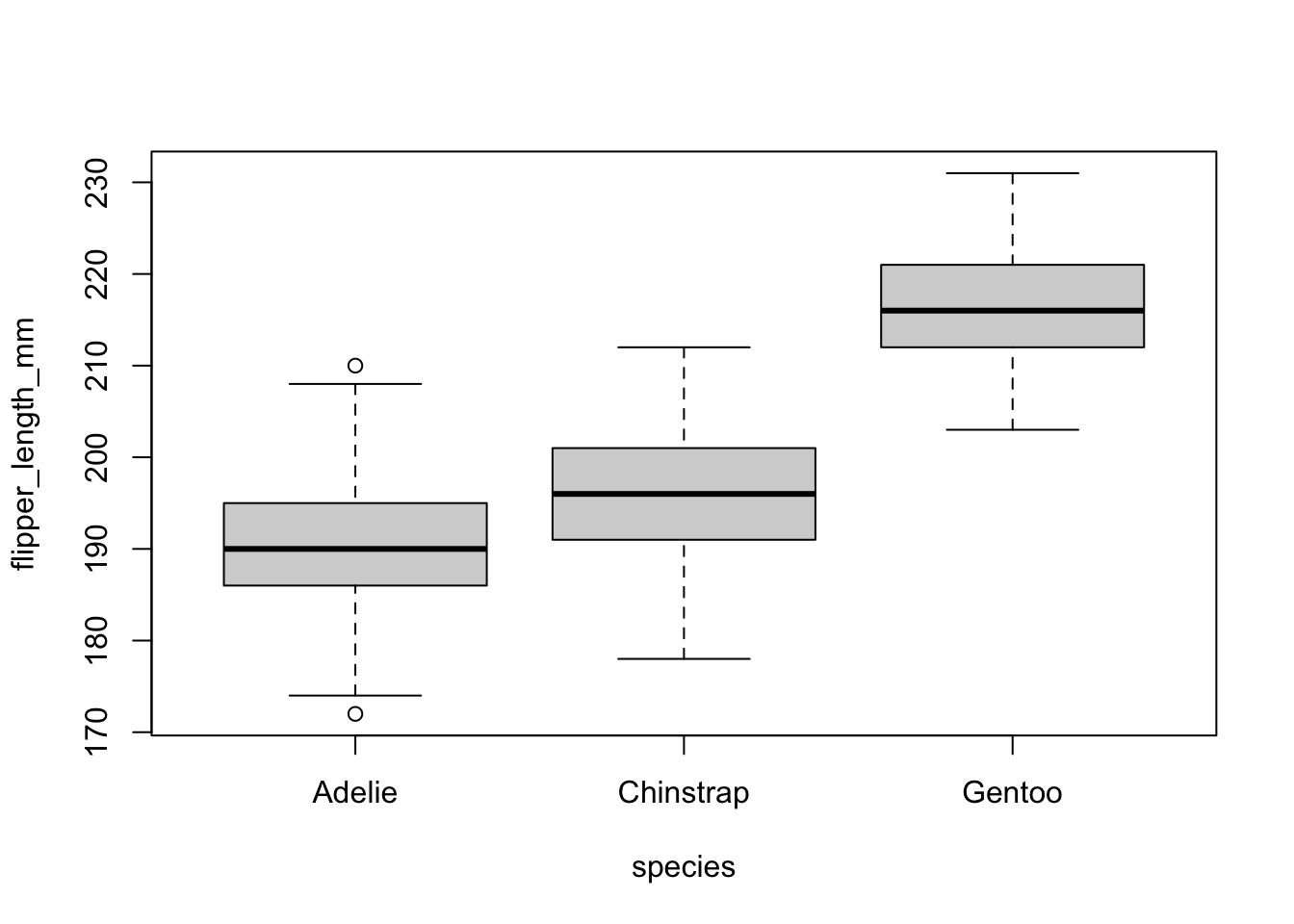
The dataset contains data for 344 penguins of 3 different species (Adelie, Chinstrap and Gentoo). The dataset contains 8 variables, but we focus only on the flipper length i.e. flipper_length_mm and the species i.e. species, so we keep only those 2 variables.
We may want to give a quick check to the groups for a visual inspection:
 boxplot(flipper_length_mm ~ species,
  data = pinguini
)
then aov(). the fuction take 2 arguments:
-
formula: left side the numeric variable, right side groups i.e.var ~ groups(much like linear regression) -
data: your data
Please refer to (tips) to undestand why data needs to come to longer format to be able to use that.
anova_pinguini =aov(flipper_length_mm ~ species,
  data = pinguini
)

anova_pinguini
#> Call:
#>    aov(formula = flipper_length_mm ~ species, data = pinguini)
#>
#> Terms:
#>                  species Residuals
#> Sum of Squares  52473.28  14953.26
#> Deg. of Freedom        2       339
#>
#> Residual standard error: 6.641529
#> Estimated effects may be unbalanced
#> 2 observations deleted due to missingness
12.2 exercises
Exercise 12.1 Let’s assume to have a sample with this data and respective belonging group:
x<-c(12,23,12,13,14,21,23,24,30,21,12,13,14,15,16)

z<-c(1,1,1,1,1,2,2,2,2,2,3,3,3,3,3)
perform anova test with aov() function testing if there is significant differences between group 1, 2 and 3.
You specify the formula, where x is the continous variable and y is the group variable.
This is how you solve it.
Exercise 12.2 Let’s consider the diet dataset in this link here The data set contains information on 76 people who undertook one of three diets (referred to as diet A, B and C). There is background information such as age, gender, and height. The aim of the study was to see which diet was best for losing weight.
to read data first dowload it from the link, then move data inside your R project. then run these commands:
diet = read.csv("< the dataset name>.csv")We will be using variable Diet, pre.weight and weight6weeks
- read data from kaggle
- compute mean weights for each group
- calculate anova on Diet against the weight cut
Exercise 12.3 We recruit 90 people to participate in an experiment in which we randomly assign 30 people to follow either program A, program B, or program C for one month.
#make this example reproducible
set.seed(0)

#create data frame
data <- data.frame(program = rep(c("A", "B", "C"), each = 30),
                   weight_loss = c(runif(30, 0, 3),
                                   runif(30, 0, 5),
                                   runif(30, 1, 7)))
- plot boxplot of weight_loss ~ program Hint: use
boxplot()function specifying the formula. - fit 1 way anova to test difference in weight loss for each program.
Exercise 12.4 Consider the maximum size of 4 fish each from 3 populations (n=12). We want to use a model that will help us examine the question of whether the mean maximum fish size differs among populations.
size <- c(3,4,5,6,4,5,6,7,7,8,9,10)
pop <- c("A","A","A","A","B","B","B","B","C","C","C","C")- visualize it through boxplot
- Using ANOVA model test whether any group means differ from another.
Exercise 12.5 Let’s consider 6 different insect sprays in InsectSprays contained in R. Let’s assume we are interested in testing if there was a difference in the number of insects found in the field after each spraying, use varibales count and spray.
12.3 solutions
Answer to Exercise 12.1:
x <- c(12,23,12,13,14,21,23,24,30,21,12,13,14,15,16)
z <- c(1,1,1,1,1,2,2,2,2,2,3,3,3,3,3)
anova <- aov( x ~ z )
summary(anova)

        Df Sum Sq Mean Sq F value Pr(>F)
z            1    1.6    1.60   0.047  **0.832**
Residuals   13  446.1   34.32
The ANOVA (formula: x ~ z) suggests that the main effect of z is statistically not significant and very small (F(1, 13) = 0.05, p = 0.832; Eta2 = 3.57e-03, 95% CI [0.00, 1.00]). That means that group means are not that different one from the other
Answer to Exercise 12.2:
At first you have to download data from https://www.kaggle.com/code/evitaginiyatullina/one-way-anova-comparison/data, then read data with:
diet <- read.csv("<your_dataset_name>.csv")then you have to compute mean weights for each group
# Compute mean weights for each group
mean_weights <- tapply(diet$weight6weeks, diet$Diet, mean)

# Calculate one-way ANOVA on Diet against weight cut
anova_result <- aov(weight6weeks ~ Diet, data = diet)

# Summary of ANOVA
summary(anova_result)
Answer to Exercise 12.3:
Plot a boxplot of weight_loss by program
boxplot(weight_loss ~ program, data = data, xlab = "Program", ylab = "Weight Loss", main = "Weight Loss by Program")Perform one-way ANOVA to test differences in weight loss by program
anova_result <- aov(weight_loss ~ program, data = data)
summary(anova_result)
The boxplot will provide a visual representation of the weight loss distribution by program, and the ANOVA will test if there are statistically significant differences in weight loss among the programs.
Answer to Exercise 12.4:
at first you need a dataframe right?
# Create a data frame
data <- data.frame(size, pop)
Visualize the data through a boxplot
boxplot(size ~ pop, data = data, xlab = "Population", ylab = "Maximum Fish Size", main = "Boxplot of Maximum Fish Size by Population")Perform one-way ANOVA to test for differences among group means
anova_result <- aov(size ~ pop, data = data)Summary of ANOVA
summary(anova_result)Answer to Exercise 12.5:
First, load the dataset if it’s not already loaded:
data(InsectSprays)Visualize the data through a boxplot to get an initial understanding of the distribution of counts for each type of insect spray:
boxplot(count ~ spray, data = InsectSprays, xlab = "Insect Spray", ylab = "Number of Insects",
        main = "Number of Insects by Insect Spray")
Perform a one-way ANOVA to test for differences in the number of insects found among the different insect sprays:
anova_result <- aov(count ~ spray, data = InsectSprays)

# Summary of ANOVA
summary(anova_result)
The boxplot will provide a visual representation of the distribution of counts by insect spray, and the ANOVA analysis will help you determine if there are statistically significant differences in the means of insect counts among the different sprays.